Wednesday, June 22, 2011

The small show which way Europe should walk.

The RES (renewable energy sources) Champions League announced its winners for the second time, this year in Prague. The RES Champions League is a network of national RES leagues, which aims at creating a positive renewable energy competition between European cities, towns and villages. According to the RES ranking, strong cities and towns are found in Germany, Italy and the Check Republic, but also other participating countries like Hungary, Poland, Bulgaria and France are showing successful and innovative example to Europe.

Besides celebrating the winners, the RES Champions League conference provided an experience ex-change, where various RES solutions used by towns and cities were presented during the conference. As being organized in Prague, it also brought a reminder about the current Czech government policy, which, in comparison with the EU accent on the green energy, is driving in opposite direction.

The final rankings can be found on RES Champions League home page. A great hurray and respect should be directed to these cities and towns for taking an entrepreneurial grip on the matter, supporting the development of renewable energy sources on a concrete level and at the same time showing direction to whole Europe. It is with thrill that we can wait and expect big cities, even metropolises to being able to implement similar solutions in a somewhat bigger scale to underpin the result of climate change mitigation even more.

CHAMP countries are already represented
CLER (France) co-ordinates the project, and the following organisations function as project partners: Solarthemen in Germany, LEA in Czech republic, PNEC in Poland, ABEA in Bulgaria, EKKE in Hungary, Legambiente in Italy, Climate Alliance in Germany, DUH in Germany

The competition is targeted at cities and towns working for the development of renewable energies. All CHAMP partners (besides Finland) can already participate, as they are represented as a nation in RES CL. It is also possible, even desirable to set up a new National RES Champion Leagues! To know more about the competition that will certainly be open again next year, please visit the web site.

The principles of the RES Champions League:
One index: based on installed power (or area) per inhabitant
Two energies: solar (photovoltaic and thermal) and wood (heat)
One general ranking (all sizes) and three divisions:
- small cities and towns (between 5,000 and 19,999 inhabitants)
- medium cities and towns (between 20,000 and 99,999 inhabitants)
- large cities and towns (more than 100,000 inhabitants)

Source: RES CL
Picture source: RES CL

Tuesday, June 14, 2011

Partnership is the key

If you want to be incrementally better: Be competitive.
If you want to be exponentially better: Be cooperative.


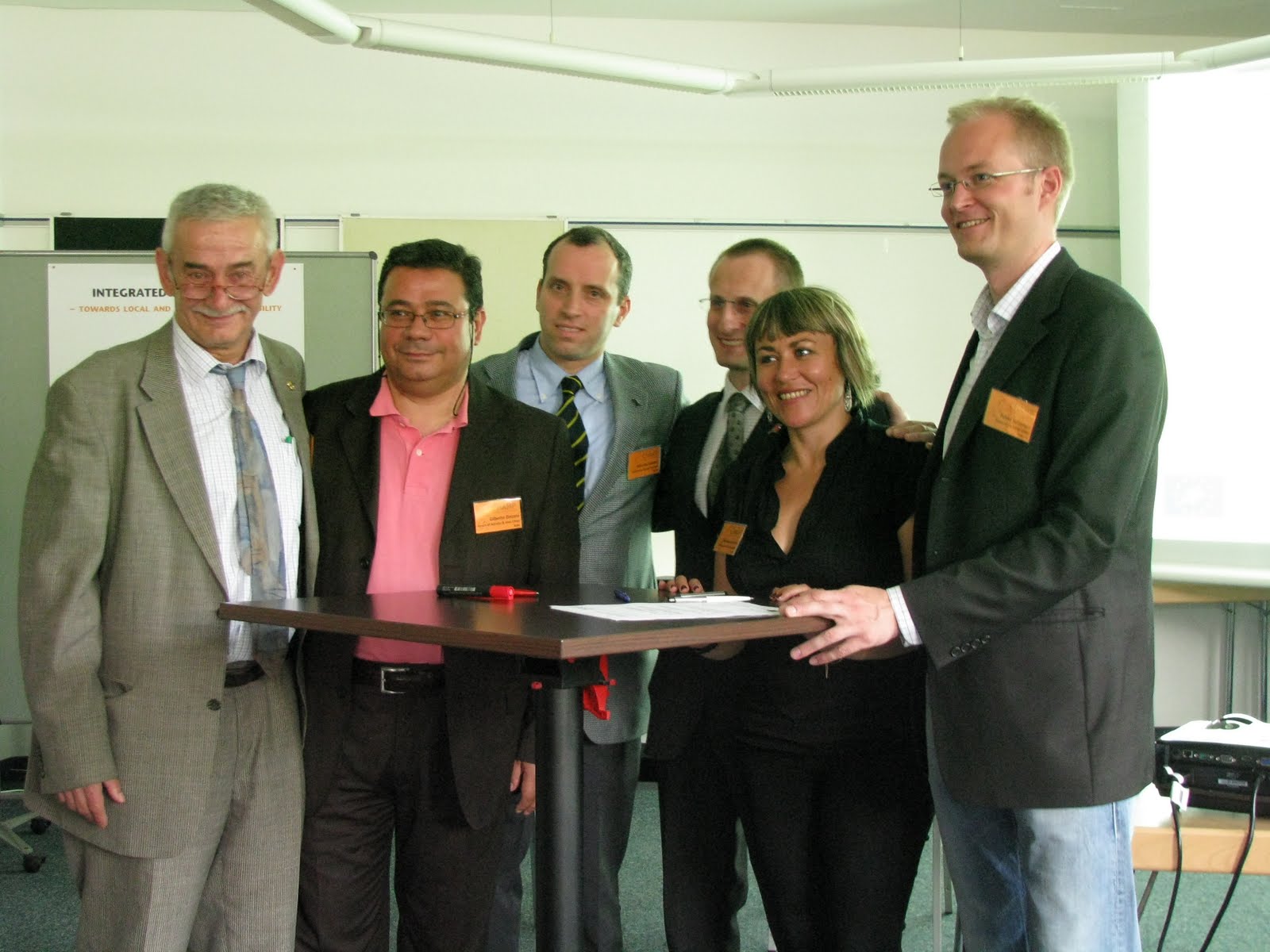
That's how the CHAMP Project Manager Pekka Salminen summed up the benefits of the newly established European Partnership for Integrated Sustainability Management. Like we wrote earlier in this blog, the European Partnership was succesfully launched in connection with the Resilient Cities 2011 conference in Bonn on June 4th.

The European Partnership was established by the CHAMP project consortium partners and new national training hubs in four other European countries or regions. The new signatories of the Partnership are SES Efficiency, and Observatory for Sustainability from Spain, the Forum of Adriatic and Ionian Cities, Sendzimir Foundation from Poland and the regional training center for local public administration Sibiu. Poland, Romania, Spain and Adriatic and Ionian region. The aim is to develop common capacity building services for local and regional authorities. This is done through National Training Hubs in each country, with a special focus on an Integrated Management System for sustainability.

We are currently searching for new national training hubs in all European countries. If your organisation might be interested, read more on the CHAMP project website!

Tuesday, May 31, 2011

Finding Win Wind solutions for Europe

The times of recession are turning and the world can go back to efficient production. Unpublished estimates from the International Energy Agency state that greenhouse gas emissions are increasing again, faster than ever, hitting records last year. Fatih Birol, chief economist of the IEA note that the United Nations-led negotiations on a new global treaty on climate change have stalled, showing also that the significance of climate change in international policy debates is much less pronounced than it was a few years ago.

At the same time the Fukushima catastrophy makes minds turn about nuclear power. Germany’s decision to shut all nuclear reactors by 2022, makes the situation on greenhouse gas emissions even more interesting. How is Germany planning to reach its ambitiously set goals on CO2 reduction? Ac-cording to Reuter, Angela Merkel’s ruling Coalition has planned to cut power use by 10 percent by 2020 and further expand the use of renewable energy such as wind and solar power. This is a piece of good news! Europe’s biggest economy has opened the doors to suppliers of renewable solutions, showing example also to others who will be affected by the closure of nuclear stations. In yesterday’s news a representative of a Finnish Wind Power provider happily expressed his enthusiasm to stand in the first row to sell their solutions around Europe.

What about the German-Russian natural gas pipeline that was completed earlier this month, and the second that is being built? Nord Stream Joint Venture is enjoying favourable times. Fukushima came just on time for a German decision on nuclear power, and a more easily accepted transition into lighting German houses through the Natural Gas pipeline that has awoke much mystification especially in the states between Europe’s two power poles. John Sauven, the executive director of Greenpeace UK, reminds about the ways politicians and other actors in the world’s great powers are eyeing up extraordinary and risky ways to extract the world's last remaining reserves of fossil fuels – even from under the melting ice of the Arctic.

Indeed, Germany is showing example on what kind of energy source is desirable to be used to reach goals on emissions reduction. I hope that the Finnish Wind Power provider will make it to the first row and has a clear throat when selling his solutions. There seems to be a somewhat bigger actor on the playground, with a stronger voice. It will not be easy to convince decision makers on the “Win Wind situation”, when gas is soon to be provided directly from underneath the surface of the Baltic Sea.

Foto: City of turku

AFP:
YLE Uutiset


The Guardian: Fiona Harvey

Friday, May 20, 2011

Summer School: Climate change in cities and city regions – Time to adapt?

I know what I'll be doing next summer - attending the interesting Summer School '''Climate change in cities and city regions - Time to adapt?''', which will take place at HafenCity University Hamburg (HCU) as part of the BaltCICA project.

The summer school will address the impact of climate change with the focus on the resulting responsibilities for the urban and rural areas at Elbe estuary. It consists of two modules, the first being a Metropolitan Adaptation Lab and the second a Scenario Workshop.

The summer school is an exciting opportunity for practitioners, students and young researchers of most diverse specializations and branches, ranging from urban and regional planning, environmental sciences, geography, social sciences, ecological sciences, technical engineers with interest in climate change and climate adaptation.

During the week the participants will attend seminars and experience the impacts of climate change in Hamburg and how the latest scientific knowledge is transferred into innovative adaptation measures. In line with that, the attendees will study many aspects of climate change and the role of planning in the Hamburg Metropolitan Region. Finally they will develop innovative solutions to adapt to a changing climate.

The Summer School will take place organized at the HafenCity University Hamburg from September 26th to 30th 2011 in Hamburg. How will you spend your summer?

See the agenda for the Summer School here and register here by May 31st!
Pictures: Stefanie Lange

Tuesday, May 10, 2011

A livable city – it can depend on so little.

Image source: http://blogs.lanacion.com.ar/ecologico/files/2011/03/entrada-549x435.jpg

Royal Philips Electronics launched in May 2010 an innovation contest Philips Livable Cities Award to find new solutions for improving health and well-being in cities. 2010-2011 has been the first year of the contest and it drew 450 ideas from 29 countries, eight of which were selected as finalists. Sabrina Faber's "Rainwater Aggregation for Yemen" was chosen as the overall winner at a ceremony two weeks ago in Amsterdam. She was granted €75,000 to start working with local contractors and associations to begin implementing the idea on the city of Sana'a buildings in Yemen.

The competition attracted innovative people to create new ways of making a difference in people’s lives. Out of the top ideas, one can find solutions in the fields of: Rainwater aggregation, Shelter from extreme weather conditions, Recreation on the streets, Sports in the city, Virtual elderly care, City re-generation, Neighbourhood and Education.

Second-place winner Manuel Rapoport's project “Plaza Movil Street Park” will create safe, portable recreational areas in Buenos Aires, Argentina, by temporarily closing streets to motorized traffic on weekends and during public holidays. These recreational facilities can be moved from one place to an-other, wherever and whenever needed.

Exactly, Why not closing one or two cross streets for Friday night moonlight Milongas? As we know also Finns are great tangueros, so bring the tango to the streets! It is possible to let the bon vivant out even within a modest Finn, it just requires space, a space meant for enjoyment, denuded of noise and distraction. Enjoying life is about those few moments; they depend on so little.

Just as important as the wellbeing of the environment, is the social wellbeing that also increases the quality of life. There are the corners in the world, where it is enough to get basic needs such as drinking water fulfilled each day, while somewhere else the recreational perspective has a bigger value. Combining these two one can bring recreation to a very simple and fundamental level, for example in the heat of dancing in an open public space – the street.

For 2011-2012 Philips is committed to building on the Livable City program’s strengths to further recognize meaningful innovations which make a real difference to people’s lives

Thursday, April 21, 2011

European Partnership on Integrated Urban Sustainability Management launched in June!

The CHAMP project consortium is launching a European Partnership on Integrated Urban Sustainability Management on the 4th of June in Brussels, in connection with the Resilient Cities Conference.

The European Partnership aims at establishing a long sustaining support structure for local sustainability. It will further develop the goals of CHAMP and serves as a competence network for exchange and knowledge growth. Moreover, it will provide members with training on integrated sustainability management and increase the interaction various campaigns and initiatives. The Partnership targets organizations that can facilitate and train local authorities in using the Integrated Management System, but it also welcomes interested local and regional authorities.

For more information about the event and the European Partnership, have a look at the CHAMP website and join us in the launching event!

Thursday, April 14, 2011

Thinking about the gender-climate link

The developing countries are experiencing the impacts of climate change first-handed. Especially women in those countries are vulnerable to ethe ffects of the changing climate. Recognizing the gender-climate link is only one point of view to the issue, but it's still a significant one.

Men and women are affected by the climate change in a different way . This is caused for instance by the distribution of work and cultural norms. Being poor makes people more vulnerable to the effects of climate change no matter if you are a man or a woman. However, according to the Food and Agriculture Organization of the United Nations (FAO), 70 % of the world's poor are women. The impacts of climate change are expected to increase poverty and thus lead to increased gender inequality, too.

Should we look at the gender aspects of climate change also in the rich north? The differences are not only visible in developing countries. For the Nordic people in general are not used to heat waves and especially the elderly, most of them being women, are severely affected by the hot weather. Certain professions in the European countries are strongly dominated by women or men. If certain professions are suffering from the changing climate, also gender effects could be notable. What is certain is that more information on the impacts of climate change from the gender point of view is needed both in the south and in the north.

Photo: UNWOMEN
More information:
UNDP Resource guide on Gender and Climate Change
Gender into Climate Change: Toolkit for climate experts and decision-makers